Skip to content
ADVERTISEMENT
Sign In
  • Sections
    • News
    • Advice
    • The Review
  • Topics
    • Data
    • Diversity, Equity, & Inclusion
    • Finance & Operations
    • International
    • Leadership & Governance
    • Teaching & Learning
    • Scholarship & Research
    • Student Success
    • Technology
    • The Workplace
  • Magazine
    • Current Issue
    • Special Issues
    • Podcast: College Matters from The Chronicle
  • Newsletters
  • Events
    • Virtual Events
    • Chronicle On-The-Road
    • Professional Development
  • Ask Chron
  • Store
    • Featured Products
    • Reports
    • Data
    • Collections
    • Back Issues
  • Jobs
    • Find a Job
    • Post a Job
    • Professional Development
    • Career Resources
    • Virtual Career Fair
  • More
  • Sections
    • News
    • Advice
    • The Review
  • Topics
    • Data
    • Diversity, Equity, & Inclusion
    • Finance & Operations
    • International
    • Leadership & Governance
    • Teaching & Learning
    • Scholarship & Research
    • Student Success
    • Technology
    • The Workplace
  • Magazine
    • Current Issue
    • Special Issues
    • Podcast: College Matters from The Chronicle
  • Newsletters
  • Events
    • Virtual Events
    • Chronicle On-The-Road
    • Professional Development
  • Ask Chron
  • Store
    • Featured Products
    • Reports
    • Data
    • Collections
    • Back Issues
  • Jobs
    • Find a Job
    • Post a Job
    • Professional Development
    • Career Resources
    • Virtual Career Fair
  • Events and Insights:
  • Leading in the AI Era
  • Chronicle Festival On Demand
  • Strategic-Leadership Program
Sign In
Proof

Why the Admissions Office May Be Part of the Problem of College Access

By Jon Boeckenstedt
December 17, 2014

Access to college is a hot issue these days, with policy makers and colleges looking for ways to enroll more low-income, first-generation, and minority students. Many people see the admissions office as a key part of the solution. But as a longtime admissions professional, I suspect just the opposite is true: That the admissions office, especially at highly selective institutions, is the agent that keeps these students out of college in the first place, by creating a game that is heavily skewed in favor of students from high-income, well-educated families.

To continue reading for FREE, please sign in.

Sign In

Or subscribe now to read with unlimited access for as low as $10/month.

Don’t have an account? Sign up now.

A free account provides you access to a limited number of free articles each month, plus newsletters, job postings, salary data, and exclusive store discounts.

Sign Up

Access to college is a hot issue these days, with policy makers and colleges looking for ways to enroll more low-income, first-generation, and minority students. Many people see the admissions office as a key part of the solution. But as a longtime admissions professional, I suspect just the opposite is true: That the admissions office, especially at highly selective institutions, is the agent that keeps these students out of college in the first place, by creating a game that is heavily skewed in favor of students from high-income, well-educated families.

I don’t believe that this is a matter of purposeful, overt discrimination, but rather a reliance on traditional means of evaluating students coming out of high school, and our own belief about what will make a student successful.

I’m a fan of digging into the numbers to better understand trends—something I do regularly on my blog, Higher Ed Data Stories. And these days the data are clear: If your parents are educated, you have a much better chance of being educated too.


Proof: An occasional series in which higher-education insiders work out new arguments using data. If you’re interested in contributing, email jeff.young@chronicle.com.


Part of the problem is right under our noses, in the strategic plans every university creates. Every admissions office feels some pressure to increase the things it is measured on: test scores, revenue, and diversity, to name a few. And it’s clear that sometimes, those goals are in conflict with one another.

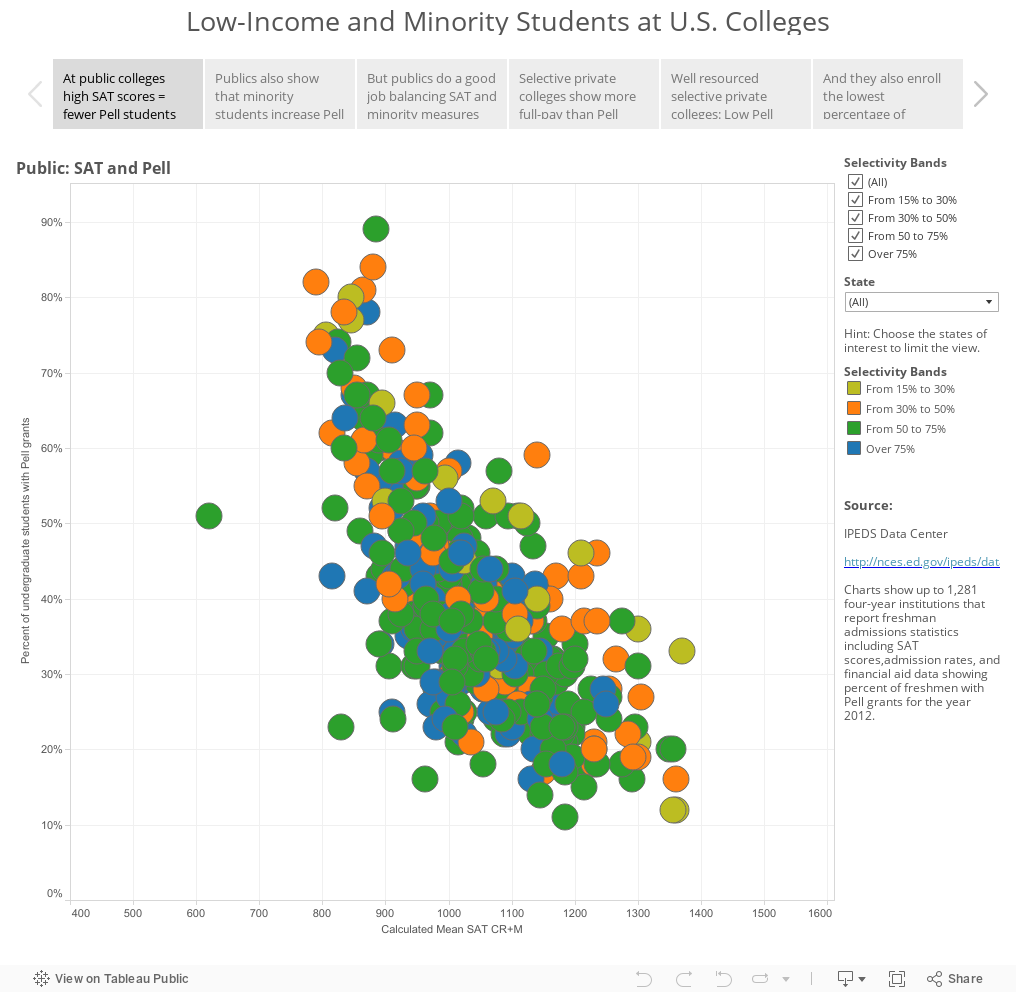
Take test scores. Colleges boast when their applicants have higher SAT scores, yet high scores are exactly what low-income students tend to lack. And so, achieving the goal of attracting high SAT-score holders may have the side effect of a class with a low percentage of students with Pell Grants, the federal program reserved for low-income students.

Analysis of another admissions test, the ACT, also shows a similar interplay of ethnicity, income, and test scores: Low-income students of color tend to congregate at the low end of the test score range, while wealthier Asian and white students cluster near the top.

So if test scores are important to your public persona, you’re going to have to find the needles in the haystack: The low-income students with high test scores, or, harder yet, the low-income minority student with high test scores. No wonder many institutions struggle.

Traditional measures of admission conspire in other ways, too.

ADVERTISEMENT

Consider the things most selective admissions offices like in their applicants: A record of success in AP or IB or honors courses; a beautifully crafted admissions essay; a glowing letter of recommendation; a long list of meaningful out-of-class experiences; or even legacy status. If no one told you as a high-school freshman you need four years of math, or foreign language; if your counselor doesn’t know you because her caseload is 1,400 students and thus she can’t write a time-consuming letter of recommendation; if you’re not blessed with college-educated family members who are going to insist that they must proof your essay; if you must forgo extracurriculars to work for spending money; or if your school doesn’t even offer advanced classes, your chances are diminished, through little or no fault of your own.

Attitudes, too, can be self-defeating. I heard a dean of admissions at one of the top brand names in higher education lament the dearth of low-income students capable of doing the work at her institution. “There just aren’t that many,” she said on stage at a national conference, after defining her institution’s definition of low-income students as those from families with income under $60,000.

ADVERTISEMENT

What about revenue? The desire for universities, both public and private, to generate more revenue via more students who need less financial aid echoes through most university halls these days, and it exposes the most delicious irony of all: Our nation’s wealthiest, most prestigious universities don’t carry their fair share of the weight when it comes to educating low-income students, despite having financial resources which would make it possible. In fact their lack of low-income students makes them what they are: prestigious, wealthy, and well known.

The push to increase enrollment of first-generation or low-income or minority students can’t come with the expectation that the admissions office do more. It has to start at the very top of our very top institutions: Those with sufficient institutional self-confidence to betray the pursuit of prestige for its own sake, those with the courage to blaze new trails, and those with the vision to redefine what prestige means.

ADVERTISEMENT

Based on the marketplace of higher education, it’s clear that this trend cannot trickle up from those middle-range institutions already carrying their fair share of the task. Vincent de Paul, who founded the order of priests that founded my own university, once observed, “There is nothing good that does not meet with opposition, and it should not be valued any less because it encounters objections.” If a few brave institutions aren’t going to take the first steps, it’s unlikely we’ll make any real progress on the problem.
Read other items in A New Approach to College Admissions.
We’d like to hear from you — tell us how The Chronicle has made a difference in your work or helped you stay informed. You can also send feedback about this article or submit a letter to the editor.
Share
  • X (formerly Twitter)
  • LinkedIn
  • Facebook
  • Email
About the Author
Jon Boeckenstedt
Jon Boeckenstedt is vice provost for enrollment management at Oregon State University.
ADVERTISEMENT
ADVERTISEMENT

More News

Former Auburn Tigers quarterback Cam Newton looks on from the stands in the first quarter between the Auburn Tigers and the Georgia Bulldogs at Jordan-Hare Stadium on October 11, 2025 in Auburn, Alabama.
'Bright and Shiny Things'
How SEC Universities Won the Enrollment Wars
Illustration of a Gold Seal sticker embossed with President Trump's face
Regulatory Clash
Trump’s Higher-Ed Policy Fight
A bouquet of flowers rests on snow, Sunday, Dec. 14, 2025, on the campus of Brown University not far from where a shooting took place, in Providence, R.I. (AP Photo/Steven Senne)
Campus Safety
No Suspects Named in Brown U. Shooting That Killed 2, Wounded 9
Several hundred protesters marched outside 66 West 12th Street in New York City at a rally against cuts at the New School on December 10, 2025.
Finance & Operations
‘We’re Being DOGE-ed’: Sweeping Buyout Plan Rattles the New School’s Faculty

From The Review

Students protest against the war in Gaza on the anniversary of the Hamas attack on Israel at Columbia University in New York, New York, on Monday, October 7, 2024. One year ago today Hamas breached the wall containing Gaza and attacked Israeli towns and military installations, killing around 1200 Israelis and taking 250 hostages, and sparking a war that has over the last year killed over 40,000 Palestinians and now spilled over into Lebanon. Photographer: Victor J. Blue for The Washington Post via Getty Images
The Review | Opinion
The Fraught Task of Hiring Pro-Zionist Professors
By Jacques Berlinerblau
Photo-based illustration of a Greek bust of a young lady from the House of Dionysos with her face partly covered by a laptop computer and that portion of her face rendered in binary code.
The Review | Essay
A Coup at Carnegie Mellon?
By Sheila Liming, Catherine A. Evans
Vector illustration of a suited man fixing the R, which has fallen, in an archway sign that says "UNIVERSITY."
The Review | Essay
Why Flagships Are Winning
By Ian F. McNeely

Upcoming Events

010825_Cybersmart_Microsoft_Plain-1300x730.png
The Cyber-Smart Campus: Defending Data in the AI Era
Jenzabar_TechInvest_Plain-1300x730.png
Making Wise Tech Investments
Lead With Insight
  • Explore Content
    • Latest News
    • Newsletters
    • Letters
    • Free Reports and Guides
    • Professional Development
    • Events
    • Chronicle Store
    • Chronicle Intelligence
    • Jobs in Higher Education
    • Post a Job
  • Know The Chronicle
    • About Us
    • Vision, Mission, Values
    • DEI at The Chronicle
    • Write for Us
    • Work at The Chronicle
    • Our Reporting Process
    • Advertise With Us
    • Brand Studio
    • Accessibility Statement
  • Account and Access
    • Manage Your Account
    • Manage Newsletters
    • Individual Subscriptions
    • Group Subscriptions and Enterprise Access
    • Subscription & Account FAQ
  • Get Support
    • Contact Us
    • Reprints & Permissions
    • User Agreement
    • Terms and Conditions
    • Privacy Policy
    • California Privacy Policy
    • Do Not Sell My Personal Information
900 19th Street, N.W., 6th Floor, Washington, D.C. 20006
© 2026 The Chronicle of Higher Education
The Chronicle of Higher Education is academe’s most trusted resource for independent journalism, career development, and forward-looking intelligence. Our readers lead, teach, learn, and innovate with insights from The Chronicle.
Follow Us
  • twitter
  • instagram
  • youtube
  • facebook
  • linkedin