With widespread delays holding up tens of thousands of foreign students worldwide from getting their visas, the “U.S. economy could suffer a loss of $7 billion,” a higher-education group warned recently.
A precipitous drop in international enrollments wouldn’t just be bad for colleges, it would be a blow to the larger economy, NAFSA: Association of International Educators admonished. Not only would tuition not be paid, plane tickets wouldn’t be booked, apartments wouldn’t be rented, and dorm-room refrigerators wouldn’t be stocked. Across the country, 60,000 jobs could be lost.
Arguments that emphasize the economic impact of international students are intended to resonate beyond campuses. What’s more, they would appear tailor-made for the country’s businessman-in-chief, who has prioritized cutting government costs and spurring economic growth.
If you don’t live in a hub for international students, “the economic argument loses its salience.”
Yet such messaging seems to be falling on deaf ears. The Trump administration has chided Columbia University for its “financial dependence” on international students. It has castigated Harvard for treating foreign students as a “giant cash cow” and attempted to boot the university from the student-visa system.
As the White House imposes punishing tariffs on America’s trade partners, education — with which the United States has a trade surplus with almost every country in the world — hasn’t been part of negotiations. The administration has threatened a 145-percent trade penalty on Chinese goods while also vowing to “aggressively revoke” the visas of students from China, a group that spends more than $14 billion annually to study here.
The “irony seems to be lost on President Trump,” said Dany Bahar, director for migration, displacement, and humanitarian policy at the Center for Global Development. “One of his signature goals, narrowing the trade deficit, is actively undermined” by his foreign-student policies.
Those policies could be bad news for colleges’ bottom lines. Many fear that new visa restrictions and attacks on colleges by President Trump and his allies could damage American higher education’s global reputation and sink international enrollments.
To the sector’s dismay, the broader public also appears unmoved by what has long been a winning case. The arguments for enrolling international students may be falling out of vogue, while the arguments against it grow in popularity. In an America First moment, the politics of immigration seem to trump the economics of overseas tuition. And among Americans skeptical, or even hostile, to higher education — well, they just might not be willing to buy colleges’ reasoning.
“The economic case for international students is increasingly falling flat in today’s climate for almost everyone,” said Chris R. Glass, a professor of educational leadership and higher education at Boston College. “In my view, the economic-impact argument is ineffective and even counterproductive.”
Let’s get this out of the way: The evidence that international students are an economic plus is abundant. Both NAFSA and the federal government publish annual calculations of international students’ financial impact. The U.S. Department of Commerce considers education one of the country’s top service exports, bigger than coal and corn, about equal to what American carmakers earn overseas.
Foreign students who pay full freight subsidize their domestic classmates and help colleges make up for funding cuts and other lost revenue. After China joined the World Trade Organization 24 years ago, Chinese families spent their new income on American degrees, research shows, setting international-enrollment records.
A new trade war “risks unraveling the United States’ competitive advantage,” said Gaurav Khanna, an associate professor of economics at the University of California at San Diego and an author of the report.
The influx of tuition dollars from China, India, and elsewhere over the last two decades coincided with a shift away from the way colleges had traditionally described the value of international students, which emphasized how the students added to campuses’ cultural diversity. In fact, higher education as a whole was being repositioned in terms of the return on investment: as a driver of local economies and as a necessity for graduates to secure a place in the middle class.
“It’s the argument that resonated” with the American public, said Brendan Cantwell, a professor of higher, adult, and lifelong education at Michigan State University. International education’s true believers might be enthusiastic about the expanded world view and deeper cultural understanding foreign students brought to campus. But many parents cared less about their kids having a roommate from another country than about their getting a credential for the job market at a good price — without necessarily realizing that foreign students helped keep the costs of that degree lower.
Some colleges started to make that argument to parents and to lawmakers anxious about tuition increases. Hometown business owners, meanwhile, made the connection that an influx of international students meant new markets for restaurant meals, winter coats, and flashy cars.
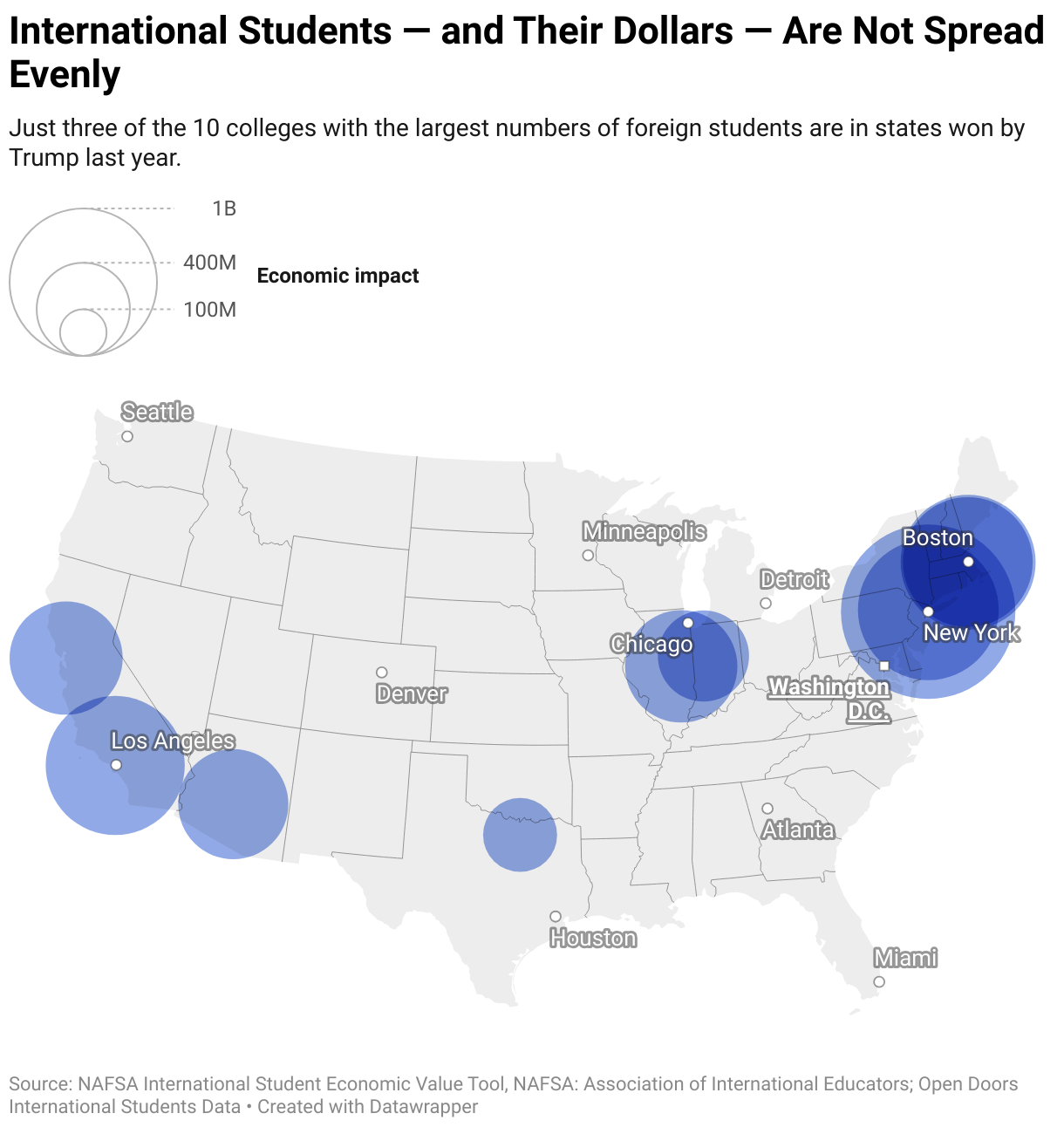
Still, Alan Ruby, a senior fellow at the Graduate School of Education at the University of Pennsylvania, said there have always been limitations to this line of thinking. After all, the 1.1 million international students, and their $44 billion in economic impact, aren’t distributed evenly throughout the United States but instead are concentrated in college towns and big cities. Of the 10 colleges with the largest international populations, two each are in Boston and New York City, with two more in California. Only three are in states won by Trump last year.
The economic activity of international students at the 10th ranked institution, the University of North Texas, is equal to all the dollars foreign students spend in Oklahoma, according to NAFSA data; in 18 other states, foreign students spent less. Students from overseas at New York University, which has both the highest enrollments of such students and the greatest economic impact from them, generated more dollars than all but eight states.
If you don’t live in a hub for international students, “the economic argument loses its salience,” Ruby said.
If the economic argument for international enrollments has lost its oomph, what else is likely to be compelling?
The case can also be muddied by the breadth and diversity of the American economy. Higher education is a multibillion-dollar export — but so too are aircraft parts, pharmaceuticals, and financial services. “Arguments about aggregate economic impact are a lot more abstract,” Ruby said, “than ‘what have you done for me lately.’”
In other countries, foreign students’ jolt to the economy may be more visible. In Australia, for example, education is among the top-five exports. And international students make up about a third of all Australian university students compared with just 6 percent of total enrollments at American colleges.
Most American colleges aren’t “truly dependent” on international students, said Philip G. Altbach, founding director of the Center for International Higher Education at Boston College, which can undercut assertions about just how essential they are.
Even if American colleges were relying on international students to keep the lights on, it’s not clear that would be a winning argument.
Trump, in fact, has tried to wield the tuition revenue that colleges like Harvard and Columbia do get against them, painting their advocacy of international students as self-interested. Bringing up the economic impact of foreign students “sounds like a self-serving talking point,” said Glass, the educational-leadership professor at Boston College. And so it backfires, feeding resentments held by Americans who are already angry at higher education — for its high costs and role as an economic gatekeeper, for its liberalism and elitism.
When a post by Glass about declining international enrollments recently went viral on social media, many of the responses crowding his mentions were celebratory. They thanked him, he said, for “sharing the good news.’”
Debates over international students may not just be influenced by polarization about higher education but colored by people’s views on globalization and, by extension, colleges’ global engagement. Trump has seized on the very real dislocation caused by the global economy to campaign and now govern on a blueprint that pits Americans against outsiders, us versus them. Immigrants, foreigners, and even international students have been the targets of policies such as visa revocations, migrant detentions, and a travel ban. The economic good of international students may not be able to transcend the politics of the moment.
If the economic argument for international enrollments has lost its oomph, what else is likely to be compelling?
Rather than focusing on short-term financial gains, advocates for foreign students — who are the majority of doctoral students in critical STEM fields — could foreground their importance to longer-term American competitiveness and innovation, Glass said, a tactic international-education groups have also pursued.
Or the economic message could be more persuasive from a different messenger. In 2020, during Trump’s first term, a group of local and state governments supported a lawsuit brought by colleges challenging a policy that would have required foreign students to return to in-person classes during the pandemic. Forcing students to leave the country would be a blow to their economies, the government officials argued. (The rule was soon rescinded.)
Fanta Aw, NAFSA’s executive director and chief executive, said that when her organization released its estimate of the effects of a sharp decline in international enrollments this fall, they had an audience beyond the White House in mind. The group highlighted the impact on a state-by-state basis and is working with educators across the country to share the data locally. If the visa backlog isn’t dealt with soon, municipal leaders won’t need a spreadsheet to calculate the costs to their community, Aw fears.
In the end, it’s the personal narrative, not the dollars and cents, that will create a sense of urgency, she said. “The economic argument is exactly the right argument, but we have to zero in on the who.”