Skip to content
ADVERTISEMENT
Sign In
  • Sections
    • News
    • Advice
    • The Review
  • Topics
    • Data
    • Diversity, Equity, & Inclusion
    • Finance & Operations
    • International
    • Leadership & Governance
    • Teaching & Learning
    • Scholarship & Research
    • Student Success
    • Technology
    • The Workplace
  • Magazine
    • Current Issue
    • Special Issues
    • Podcast: College Matters from The Chronicle
  • Newsletters
  • Events
    • Virtual Events
    • Chronicle On-The-Road
    • Professional Development
  • Ask Chron
  • Store
    • Featured Products
    • Reports
    • Data
    • Collections
    • Back Issues
  • Jobs
    • Find a Job
    • Post a Job
    • Professional Development
    • Career Resources
    • Virtual Career Fair
  • More
  • Sections
    • News
    • Advice
    • The Review
  • Topics
    • Data
    • Diversity, Equity, & Inclusion
    • Finance & Operations
    • International
    • Leadership & Governance
    • Teaching & Learning
    • Scholarship & Research
    • Student Success
    • Technology
    • The Workplace
  • Magazine
    • Current Issue
    • Special Issues
    • Podcast: College Matters from The Chronicle
  • Newsletters
  • Events
    • Virtual Events
    • Chronicle On-The-Road
    • Professional Development
  • Ask Chron
  • Store
    • Featured Products
    • Reports
    • Data
    • Collections
    • Back Issues
  • Jobs
    • Find a Job
    • Post a Job
    • Professional Development
    • Career Resources
    • Virtual Career Fair
  • Events and Insights:
  • Leading in the AI Era
  • Chronicle Festival On Demand
  • Strategic-Leadership Program
Sign In
News

From Public Good to Private Good

How Higher Education Got to a Tipping Point

Sarah Hebel CHE
By Sara Hebel
March 2, 2014

A mericans are losing the will to pay for their public colleges. They still view a higher education as essential for their personal prospects, for getting a good job and achieving financial security. But they don’t want states spending more of their money or raising their taxes to sustain the campuses that educate the majority of the nation’s students.

Once embraced as a collective good, a public higher education is increasingly viewed—and paid for—as a private one.

Q. Why is this happening?
A.
Decisions by policy makers on both the right and the left have played a role. College officials, too, have struggled to make the case that higher education should move up the list of statehouse priorities.

Antitax activists have repeatedly succeeded in capping government spending. Conservative lawmakers who view higher education as a bloated enterprise believe that colleges should simply learn to live with less.

Medicaid Consumes Larger Share of State Budgets

Politicians who are generally sympathetic to higher education haven’t been much help. When budgets have been tight, they have first protected other priorities—prisons, roads, elementary and secondary schools. The costs of entitlement programs they created decades ago are rising, taking more and more money off the table. One in 10 state dollars went to Medicaid in 1987, according to the National Association of State Budget Officers. By 2012, close to one in four dollars did.

Americans also don’t have much interest in paying more. In a recent Gallup Poll they said they valued higher education. But fewer than two in five said they strongly agreed that state governments should provide more support to colleges.

Q. Are colleges the problem? Are they simply spending too much?
A.
Colleges’ spending patterns do raise important questions.

Public College Spending Remains About the Same

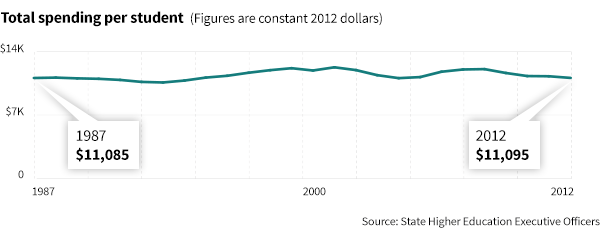
How much colleges spend has been scrutinized. But the amount per student is nearly the same as a generation ago.
Studies have shown, for example, that spending on instruction has declined slightly over time, as administrative and other costs have grown. New administrative positions are driving an expansion of the college work force, according to the Delta Cost Project. And spending on athletics, another of the project’s studies concluded, can sometimes come at the expense of academic goals.

Other costs that come under attack, such as the notorious climbing walls in campus recreation centers, make just a tiny dent in colleges’ bottom lines. But they often take on symbolic significance that can weaken public colleges’ argument for more state aid.

So it is true that colleges could make different choices in how they spend their money—and whether they should do so probably will always be a matter of debate.

But it is also true that there is no evidence of excessive growth in how much public colleges are spending. The $11,000 per student in 2012, according to the State Higher Education Executive Officers, was almost exactly the same, when inflation is taken into account, as they spent a generation ago.

Q. Just how much do states spend on higher education? And how sharp are the declines?
A. States still give a lot of money to colleges, a total of $81.3-billion in the 2012 fiscal year, according to the most recent data from the executive officers’ group.

The amount states spend on higher education is about half as much as they spend on elementary and secondary schools, according to the budget officers’ association, and more than they provide for prisons and for roads.

State money for higher education is going up in absolute terms over time. But it is not keeping up with inflation and with increases in enrollment. When measured per student, state spending on instruction at public colleges is at its lowest since 1980 (adjusted for inflation), the executive officers’ group said.

The ups and downs of state budgets change the fortunes of higher education from year to year. The trends vary across states, but, over all, the good years have been unable to make up for the lean ones. Add to that the growing pressures on state budgets, as health-care and other costs escalate, and the result is long-term decline.

When State Money Is Projected to End

If trends from 1980 to now continue, state spending on colleges will eventually cease. When states are projected to hit that mark:
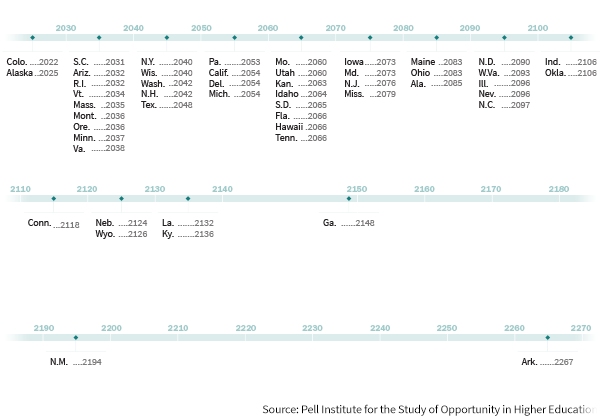
One higher-education policy analyst, Tom Mortenson, has projected that—if the spending trends from 1980 through last year continue—state aid for higher education in Colorado will reach zero within a decade. By 2050, 15 other states’ spending on colleges would, too.

Q. Where does all this leave us?
A.
We are at a tipping point.

Students are about to pay a larger share of the costs of a public education than that of states. In almost half of states, they already do.

That’s a significant change from even a decade ago, when students picked up about one-third of the tab and states paid the rest. Public colleges’ growing reliance on tuition means that student debt, which has already topped $1-trillion, is poised only to rise.

State-budget cuts sometimes threaten access, or at least limit students’ choices. Some universities have scaled back aid programs for low-income students. Others have had to cap enrollment. Public colleges are facing a growing disadvantage in the labor market, too, as the gap widens between the pay of professors at public and private colleges.

Some politicians and taxpayers say a college degree should, in fact, be treated as a private good, designed primarily to provide financial and social benefits to the individual. To them, shrinking budgets signal not crisis but progress.

But that view of higher education is narrow, college leaders and their supporters counter. It ignores the broad reach of academic research and the economic advantages of an educated citizenry. All of us should be willing to pay, they say, because it is all of us who benefit.

To continue reading for FREE, please sign in.

Sign In

Or subscribe now to read with unlimited access for as low as $10/month.

Don’t have an account? Sign up now.

A free account provides you access to a limited number of free articles each month, plus newsletters, job postings, salary data, and exclusive store discounts.

Sign Up

A mericans are losing the will to pay for their public colleges. They still view a higher education as essential for their personal prospects, for getting a good job and achieving financial security. But they don’t want states spending more of their money or raising their taxes to sustain the campuses that educate the majority of the nation’s students.

Once embraced as a collective good, a public higher education is increasingly viewed—and paid for—as a private one.

Q. Why is this happening?
A.
Decisions by policy makers on both the right and the left have played a role. College officials, too, have struggled to make the case that higher education should move up the list of statehouse priorities.

Antitax activists have repeatedly succeeded in capping government spending. Conservative lawmakers who view higher education as a bloated enterprise believe that colleges should simply learn to live with less.

Medicaid Consumes Larger Share of State Budgets

Politicians who are generally sympathetic to higher education haven’t been much help. When budgets have been tight, they have first protected other priorities—prisons, roads, elementary and secondary schools. The costs of entitlement programs they created decades ago are rising, taking more and more money off the table. One in 10 state dollars went to Medicaid in 1987, according to the National Association of State Budget Officers. By 2012, close to one in four dollars did.

Americans also don’t have much interest in paying more. In a recent Gallup Poll they said they valued higher education. But fewer than two in five said they strongly agreed that state governments should provide more support to colleges.

Q. Are colleges the problem? Are they simply spending too much?
A.
Colleges’ spending patterns do raise important questions.

Public College Spending Remains About the Same

How much colleges spend has been scrutinized. But the amount per student is nearly the same as a generation ago.

Studies have shown, for example, that spending on instruction has declined slightly over time, as administrative and other costs have grown. New administrative positions are driving an expansion of the college work force, according to the Delta Cost Project. And spending on athletics, another of the project’s studies concluded, can sometimes come at the expense of academic goals.

Other costs that come under attack, such as the notorious climbing walls in campus recreation centers, make just a tiny dent in colleges’ bottom lines. But they often take on symbolic significance that can weaken public colleges’ argument for more state aid.

So it is true that colleges could make different choices in how they spend their money—and whether they should do so probably will always be a matter of debate.

But it is also true that there is no evidence of excessive growth in how much public colleges are spending. The $11,000 per student in 2012, according to the State Higher Education Executive Officers, was almost exactly the same, when inflation is taken into account, as they spent a generation ago.

Q. Just how much do states spend on higher education? And how sharp are the declines?
A. States still give a lot of money to colleges, a total of $81.3-billion in the 2012 fiscal year, according to the most recent data from the executive officers’ group.

The amount states spend on higher education is about half as much as they spend on elementary and secondary schools, according to the budget officers’ association, and more than they provide for prisons and for roads.

State money for higher education is going up in absolute terms over time. But it is not keeping up with inflation and with increases in enrollment. When measured per student, state spending on instruction at public colleges is at its lowest since 1980 (adjusted for inflation), the executive officers’ group said.

The ups and downs of state budgets change the fortunes of higher education from year to year. The trends vary across states, but, over all, the good years have been unable to make up for the lean ones. Add to that the growing pressures on state budgets, as health-care and other costs escalate, and the result is long-term decline.

When State Money Is Projected to End

If trends from 1980 to now continue, state spending on colleges will eventually cease. When states are projected to hit that mark:

One higher-education policy analyst, Tom Mortenson, has projected that—if the spending trends from 1980 through last year continue—state aid for higher education in Colorado will reach zero within a decade. By 2050, 15 other states’ spending on colleges would, too.

Q. Where does all this leave us?
A.
We are at a tipping point.

Students are about to pay a larger share of the costs of a public education than that of states. In almost half of states, they already do.

That’s a significant change from even a decade ago, when students picked up about one-third of the tab and states paid the rest. Public colleges’ growing reliance on tuition means that student debt, which has already topped $1-trillion, is poised only to rise.

State-budget cuts sometimes threaten access, or at least limit students’ choices. Some universities have scaled back aid programs for low-income students. Others have had to cap enrollment. Public colleges are facing a growing disadvantage in the labor market, too, as the gap widens between the pay of professors at public and private colleges.

Some politicians and taxpayers say a college degree should, in fact, be treated as a private good, designed primarily to provide financial and social benefits to the individual. To them, shrinking budgets signal not crisis but progress.

But that view of higher education is narrow, college leaders and their supporters counter. It ignores the broad reach of academic research and the economic advantages of an educated citizenry. All of us should be willing to pay, they say, because it is all of us who benefit.

We’d like to hear from you — tell us how The Chronicle has made a difference in your work or helped you stay informed. You can also send feedback about this article or submit a letter to the editor.
Tags
Law & Policy
Share
  • X (formerly Twitter)
  • LinkedIn
  • Facebook
  • Email
Sarah Hebel CHE
About the Author
Sara Hebel
As assistant managing editor at The Chronicle of Higher Education, Sara Hebel oversaw a team of editors and reporters who covered broad trends in higher education, including the changes, problems, and questions that confront colleges and the people who grapple with them.
ADVERTISEMENT
ADVERTISEMENT

More News

Former Auburn Tigers quarterback Cam Newton looks on from the stands in the first quarter between the Auburn Tigers and the Georgia Bulldogs at Jordan-Hare Stadium on October 11, 2025 in Auburn, Alabama.
'Bright and Shiny Things'
How SEC Universities Won the Enrollment Wars
Illustration of a Gold Seal sticker embossed with President Trump's face
Regulatory Clash
Trump’s Higher-Ed Policy Fight
A bouquet of flowers rests on snow, Sunday, Dec. 14, 2025, on the campus of Brown University not far from where a shooting took place, in Providence, R.I. (AP Photo/Steven Senne)
Campus Safety
No Suspects Named in Brown U. Shooting That Killed 2, Wounded 9
Several hundred protesters marched outside 66 West 12th Street in New York City at a rally against cuts at the New School on December 10, 2025.
Finance & Operations
‘We’re Being DOGE-ed’: Sweeping Buyout Plan Rattles the New School’s Faculty

From The Review

Students protest against the war in Gaza on the anniversary of the Hamas attack on Israel at Columbia University in New York, New York, on Monday, October 7, 2024. One year ago today Hamas breached the wall containing Gaza and attacked Israeli towns and military installations, killing around 1200 Israelis and taking 250 hostages, and sparking a war that has over the last year killed over 40,000 Palestinians and now spilled over into Lebanon. Photographer: Victor J. Blue for The Washington Post via Getty Images
The Review | Opinion
The Fraught Task of Hiring Pro-Zionist Professors
By Jacques Berlinerblau
Photo-based illustration of a Greek bust of a young lady from the House of Dionysos with her face partly covered by a laptop computer and that portion of her face rendered in binary code.
The Review | Essay
A Coup at Carnegie Mellon?
By Sheila Liming, Catherine A. Evans
Vector illustration of a suited man fixing the R, which has fallen, in an archway sign that says "UNIVERSITY."
The Review | Essay
Why Flagships Are Winning
By Ian F. McNeely

Upcoming Events

010825_Cybersmart_Microsoft_Plain-1300x730.png
The Cyber-Smart Campus: Defending Data in the AI Era
Jenzabar_TechInvest_Plain-1300x730.png
Making Wise Tech Investments
Lead With Insight
  • Explore Content
    • Latest News
    • Newsletters
    • Letters
    • Free Reports and Guides
    • Professional Development
    • Events
    • Chronicle Store
    • Chronicle Intelligence
    • Jobs in Higher Education
    • Post a Job
  • Know The Chronicle
    • About Us
    • Vision, Mission, Values
    • DEI at The Chronicle
    • Write for Us
    • Work at The Chronicle
    • Our Reporting Process
    • Advertise With Us
    • Brand Studio
    • Accessibility Statement
  • Account and Access
    • Manage Your Account
    • Manage Newsletters
    • Individual Subscriptions
    • Group Subscriptions and Enterprise Access
    • Subscription & Account FAQ
  • Get Support
    • Contact Us
    • Reprints & Permissions
    • User Agreement
    • Terms and Conditions
    • Privacy Policy
    • California Privacy Policy
    • Do Not Sell My Personal Information
900 19th Street, N.W., 6th Floor, Washington, D.C. 20006
© 2026 The Chronicle of Higher Education
The Chronicle of Higher Education is academe’s most trusted resource for independent journalism, career development, and forward-looking intelligence. Our readers lead, teach, learn, and innovate with insights from The Chronicle.
Follow Us
  • twitter
  • instagram
  • youtube
  • facebook
  • linkedin